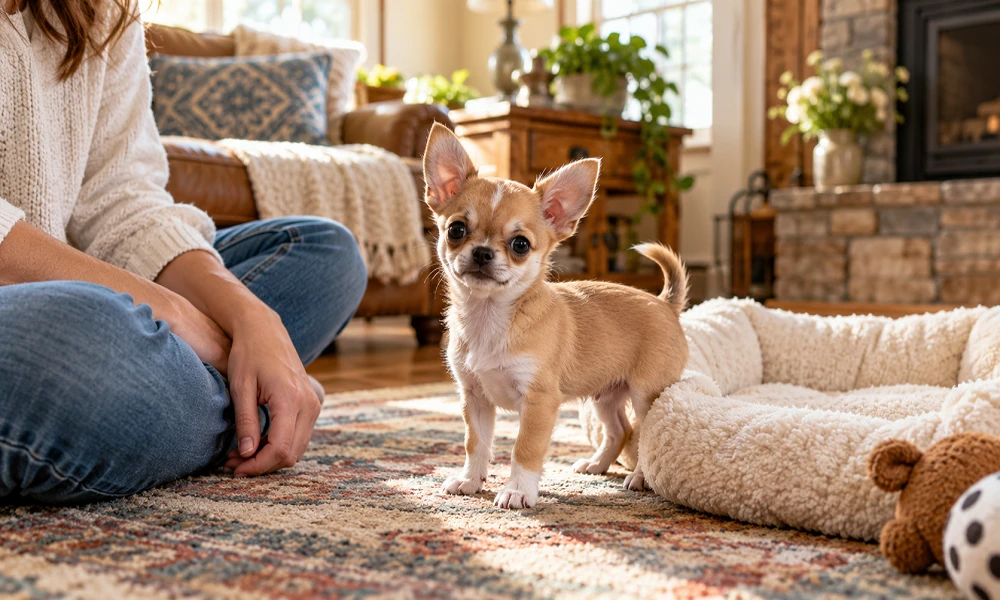
Bringing home a Chihuahua puppy is one of the most exciting things you can do – and one of the most important things you can prepare for. After more than 20 years of raising Chihuahuas here at Dreamer’s Pups on our 12-acre property in rural West Tennessee, I can tell you that the families who have the smoothest first weeks are the ones who prepare before pickup day, not after.
When you choose a Chihuahua breeder in Tennessee, the handover process should give you far more than just a puppy. You should leave with vaccination and deworming records, a written health guarantee, a clear feeding schedule, and the confidence to reach out anytime a question comes up. At Dreamer’s Pups, I raise every puppy in my home alongside children, which means they arrive already familiar with busy households, gentle hands, and the sounds of everyday family life. That head start matters – but the habits you build in the first seven days will shape your puppy’s confidence for years to come.
This checklist pulls together everything I guide new families through, broken down day by day so nothing feels overwhelming.
Before Arrival: Prepare a Safe, Small Space
Chihuahuas are tiny – even a full-grown one typically weighs between two and six pounds – and that small size means your home has hazards you may never have thought twice about. Before your puppy arrives, get down to floor level and look at your home from their perspective.
Walk through every room your puppy will have access to and address the following:
- Secure all electrical cords. Puppies chew, and a live cord can be fatal for a dog this size.
- Pick up anything small enough to swallow. Coins, hair ties, children’s toy parts, rubber bands – these are all choking hazards.
- Block off stairs and tight gaps. Chihuahuas are curious and agile, but a fall from even a moderate height can cause a serious injury in a dog this small.
- Designate a small, warm resting area. This is especially important in Tennessee’s cooler months. Chihuahuas are sensitive to cold, and a draft near their sleeping spot can affect their health quickly.
- Set up shallow food and water bowls. Standard dog bowls can actually be too deep for a young Chihuahua puppy; shallow dishes make eating and drinking much easier.
- Have a lightweight, well-fitted harness ready. I always recommend a harness over a collar for Chihuahuas – their necks are delicate, and a harness distributes pressure safely across the chest.
- Agree on a consistent potty spot and make sure everyone in the household knows the routine before the puppy comes home.
Before pickup, reach out to your breeder and ask for the puppy’s current feeding schedule, sleep pattern, and any quirks they’ve noticed. Written notes are worth their weight in gold during that first week when your brain is running on excitement and you’ve had less sleep than you planned.
Days One to Three: Keep Things Calm and Quiet
I know how tempting it is to show your new puppy off to everyone who loves you. But those first 48 to 72 hours are genuinely critical for a tiny dog adjusting to a brand-new world. Everything in your home – the smells, the sounds, the flooring, the faces – is unfamiliar to them.
The single best thing you can do is slow down.
Set your puppy’s food, water, and a comfortable bed in their designated area. Sit nearby, speak softly, and let them come to you on their own terms. Resist the urge to pick them up constantly. Little Chihuahuas need to feel safe, not smothered – even when your instinct is to cuddle them every second (and I completely understand that instinct).
Keep the household quieter than normal for those first few days. Hold off on the welcome party until your puppy has found their footing. Limit the number of new people they meet at once.
Consistency is your best tool here. Do not change the food, the sleeping arrangement, or the daily schedule all at once. The more familiar things feel, the faster your puppy will settle. If you need to transition to a different food eventually, do it gradually over seven to ten days to avoid an upset stomach.
Adjustment is a process, not an event. The first week should not be a deadline for confidence or perfect behavior – it should be a gentle introduction.
Within 72 Hours: Complete the Veterinary Handover
This step is non-negotiable, and I say that as someone who has been doing this since 2005 – it protects both your puppy and your peace of mind.
The Dreamer’s Pups adoption agreement requires that you have your puppy examined by a licensed veterinarian within 72 hours of taking them home, and that documentation reaches us within ten days for the health guarantee to apply. Here is how to make that appointment go smoothly:
- Schedule the appointment before pickup day so you are not scrambling.
- Bring every document you received from the breeder – vaccination records, deworming history, and the health guarantee itself.
- Read the full adoption agreement in advance so you understand what is covered, what is excluded, and what the timeframes are.
- Ask your vet about the next steps – what vaccines are still due, when heartworm prevention should begin, and whether the puppy’s weight is on track.
One thing I always tell new families: your puppy is up to date on shots and worming at the time of handover, but that does not mean the vaccination series is complete. Young puppies require a series of boosters at specific intervals, and your vet will map those out for you. Keep those records somewhere you can find them easily.
Every Day: Prioritize Feeding and Observation
Chihuahua puppies have very high metabolisms and very small bodies, which means they can develop low blood sugar – also called hypoglycemia – if they go too long without eating or if they are stressed. This is one of the most important health facts to understand in your first week.
Signs of low blood sugar include unusual lethargy, trembling, glassy eyes, and unsteadiness on their feet. If you ever see these signs, offer a small amount of honey or corn syrup on the gums and contact your vet immediately. Do not dismiss these symptoms as tiredness or adjustment – act quickly.
To help prevent hypoglycemia:
- Feed young puppies three to four small meals per day rather than one or two larger ones.
- Always have fresh water available in a shallow bowl they can reach easily.
- Follow the feeding plan your breeder provided. If you need to switch foods, do it gradually over a week or more.
- Keep a simple log of what your puppy eats, when they sleep, and what their energy looks like. This makes it far easier to describe any concerns to your vet or breeder.
Beyond feeding, daily observation is one of your most valuable tools. You are learning your puppy’s normal, so that anything unusual stands out. Changes in appetite, energy, bathroom habits, or coat condition are all worth noting – and worth asking about.
Throughout the Week: Build a Simple, Consistent Potty Routine
Chihuahuas are smart, and they respond extremely well to consistency and positive reinforcement. The key to a smooth potty training process is making the right choice easy for them over and over again.
Every time your puppy wakes up, after every meal, and after any period of play, take them directly to the designated potty spot. Use the same word or phrase each time so they begin to associate it with the action. When they go in the right place, reward them immediately and warmly – a cheerful “good girl!” and a small treat go a long way.
When accidents happen – and they will – clean them up quickly with an enzymatic cleaner that fully neutralizes the odor. Puppies are drawn back to spots that smell like previous accidents, so thorough cleaning matters. Avoid any scolding after the fact; they cannot connect a correction to something that happened even a minute ago, and it will only make them anxious.
In cold or wet Tennessee weather, make sure the outdoor potty area is accessible and reasonably dry. A puppy who is shivering will not focus on the task at hand.
If you are struggling to establish a consistent routine, write down your questions and reach out to your breeder. That is exactly what post-adoption support is for.
As Confidence Grows: Introduce Family Members Gently
Chihuahuas are famously big personalities in very small packages. They bond deeply with their people, but they do best when socialization happens at their pace – not ours.
When introducing children, have them sit on the floor rather than reaching down from above. Ask them to move slowly, keep their voices calm, and let the puppy come to them. Explain that no chasing, no cornering, and no lifting without an adult’s help are the house rules for now. Watch for the puppy’s body language: if they turn away, freeze, or tuck their tail, they are telling you they need a moment.
Household sounds – the vacuum, the blender, the television – can be introduced gradually. There is no rush. Short, positive experiences build confidence much more effectively than throwing a puppy into every situation at once.
Before bringing your puppy to dog parks, pet stores, or other high-traffic areas, get clearance from your veterinarian. Until the vaccination series is complete, exposure to unknown dogs and environments carries real health risks for a puppy this young.
Finish the Week with Support in Place
By the end of that first week, you should have completed your veterinary visit, established a feeding routine, started a consistent potty schedule, and begun to see your puppy’s personality emerge. Every Chihuahua is different – some are bold right away, others need an extra week or two to fully come out of their shell. Both are completely normal.
At Dreamer’s Pups, we send every puppy home with a care packet, and our support does not end at pickup. Whether you have a question about feeding, a concern about a behavior, or just want to share a photo, reach out. I have been matching families with Chihuahuas since 2005, and I genuinely love hearing how my puppies are doing.
The first week lays the foundation. Take it slowly, stay consistent, and trust the process – you and your puppy will find your rhythm.
Visit Dreamer’s Pups to discuss preparation, care instructions, and ongoing support when choosing a reputable Chihuahua breeder in Tennessee.