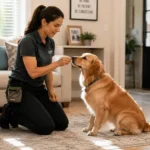
He went to kennels for five days. He came back fine – tired, pleased to see you, ate his dinner.
Then on Tuesday there’s mucus, on Wednesday he’s asking to go out every twenty minutes and producing almost nothing, and by Thursday there’s a streak of fresh blood in it and you’re on the phone.
Stress-related colitis is one of the most common presentations in general practice, and the delay is what catches owners out. The stressful thing was last week. The consequences are this week.
The gut and the brain are directly wired together
Not metaphorically. There’s a physical nerve connection between the two, plus a constant chemical conversation running in both directions.
When a dog is stressed, several things happen at once. Blood is diverted away from the digestive tract towards muscle. Gut motility changes – sometimes speeding up, sometimes slowing. Secretions alter. Cortisol rises and stays elevated for hours after the event. And the bacterial population itself shifts measurably within days.
The result is a large intestine that’s inflamed and irritable. That’s colitis: small volumes, high frequency, urgency, straining, jelly-like mucus, and often streaks of fresh red blood on the surface.
Which is also why the two halves of managing it are inseparable. Reducing the stress matters, and so does supporting the gut through it – the Best Probiotic for Dogs in this context is the one you can start a fortnight before a known stressor and keep going for a fortnight after, rather than one you open when the mucus appears.
What sets it off
Boarding kennels or a new sitter. The classic.
Moving house, including the packing weeks beforehand.
Fireworks season and thunderstorms.
A new baby, a new dog, or a new person in the house.
Being left alone, in a dog who struggles with it.
Travel, particularly long journeys.
Vet visits, grooming, and hospital stays.
A change in the household routine – someone’s work pattern changing, children going back to school.
Building work. Underrated, and it goes on for weeks.
Note how many of these are things the owner considers positive or neutral. A dog doesn’t distinguish between good disruption and bad disruption; he registers that things are not as they were.
Which dogs get it
Not evenly distributed, and knowing whether yours is a candidate is worth something.
Dogs who were anxious to begin with. A dog with a high baseline has less room before a disruption tips him over.
Rescue dogs, particularly in the first year. More change, less predictability, and often an unknown history.
Dogs with a history of gut trouble. A population that’s already less diverse – after antibiotics, or illness, or years of sensitive digestion – is less resilient to a stressful week.
Certain breeds seem over-represented, with german shepherds and working line collies coming up repeatedly in practice, though how much of that is temperament and how much is genetics isn’t clear.
Young dogs and old dogs, at both ends, for different reasons.
The dogs who rarely get it are the settled, confident, middle-aged ones on a stable routine. Which is a fair description of what you’re aiming for with everything else in this article.
The timing
Usually twenty-four to seventy-two hours after the event, which is why the connection gets missed.
A dog who has a difficult Saturday is often fine on Sunday and has colitis on Monday. Owners spend the Monday interrogating the food.
The other pattern is cumulative. No single event was enough, but a fortnight of small disruptions stacked up and the gut gave way at the end of it.
What it looks like, specifically
Small amounts, very often. He asks to go out repeatedly and produces very little.
Urgency and straining, sometimes with accidents indoors in a house-trained dog.
Mucus – clear or yellowish jelly coating the stool, or passed on its own.
Fresh red blood streaked on the surface. Alarming to see and usually not serious in itself, because it’s from the inflamed colon wall rather than internal bleeding.
A dog who is otherwise well. Eating, bright, normal energy.
That last point is the useful one. Colitis in a bright dog who’s eating is a different situation from diarrhoea in a dog who’s flat, off his food or vomiting.
What to do about it
Keep everything else as normal as you can. Same food, same times, same walks. This is not the moment to change anything, and every additional variable makes it harder to know what’s happening.
Add fibre. Colitis responds to it better than almost anything else. Psyllium husk or plain tinned pumpkin, introduced over a couple of days.
Smaller, more frequent meals. Three or four rather than two.
Reduce demands. Short, quiet, familiar walks. No training class, no dog park, no visitors if you can help it.
Keep the gut support going.
Most episodes settle within three to five days on that alone.
When to involve the vet
Ring if there’s more than a streak of blood, if he’s vomiting as well, if he seems unwell rather than just uncomfortable, if it hasn’t improved in three or four days, or if it keeps recurring.
Some dogs benefit from a short course of something specific, and there are prescription gastrointestinal diets formulated for exactly this. Antibiotics are prescribed less often for this than they used to be, and for good reason – most colitis isn’t bacterial, and antibiotics make the underlying dysbiosis worse.
Recurrent colitis in particular deserves proper investigation. Faecal testing, and a conversation about whether there’s food-responsive disease underneath the stress trigger.
The vicious circle
Worth naming, because it explains dogs who seem to get progressively worse.
A dog with an uncomfortable gut is a dog carrying low-level physical discomfort all day. Discomfort lowers his threshold for everything else – he’s more reactive, less settled, less able to cope with the next disruption. Which produces more stress, which produces more colitis.
Breaking it usually needs both ends worked on at once: the anxiety and the gut. Treating one and ignoring the other is why some dogs plateau.
There’s also emerging research on the microbiome’s influence on behaviour, which suggests the arrow points in both directions rather than just from brain to gut. It’s early days and it’s consistent with what a lot of owners describe.
The thing owners get wrong
Almost everyone, faced with mucus and blood, changes the food.
It’s understandable and it’s usually the wrong move. You’ve now introduced a second disruption on top of the first, at exactly the point the gut is least able to cope with one, and you’ve made it impossible to tell what caused what.
If your dog has just been through something stressful and his stools have gone, keep the food exactly as it is. Add fibre, keep the routine steady, and give it three or four days.
Change the food later, deliberately, when everything is settled – if you still think it needs changing at all, which after a stress episode you usually won’t.
Preventing the next one
You usually know what’s coming. Fireworks are dated. The holiday is booked. The building work starts in March.
Start the gut support two to four weeks beforehand rather than on the day, because the population takes that long to establish. Add fibre in the run-up. Keep the routine as intact as you can through the disruption.
For boarding specifically, do a trial stay well in advance, send his own food measured into daily bags, and send an unwashed blanket. Ask them not to give their own treats.
And build a couple of quiet days into the other side. A dog who comes home from kennels on Sunday and goes to a busy park on Monday is being asked for more than he’s got.
Making a boarding stay easier
Since kennels are the single most common trigger, it’s worth being specific about this one.
Do a trial run – a day, then an overnight – weeks before the actual holiday. It halves the novelty, and it tells you whether the place suits him before you’re committed.
Send his own food, weighed into daily bags, and enough for the trip plus two days. Changing diet on top of the stress is how a difficult week becomes a bad fortnight.
Send an unwashed blanket and, if they allow it, his own bed. Familiar smell does real work.
Ask them explicitly not to give their own treats. Most kennels hand something out at bedtime as a matter of course, and it’s rarely mentioned.
Write his routine down and hand it over rather than explaining it at the door. Staff change shifts; paper doesn’t.
And keep the gut support running for a fortnight either side rather than stopping the day you collect him. The decompression period is when the colitis actually appears.
When it’s not stress
If the pattern doesn’t fit – colitis with no identifiable trigger, in a dog whose life is entirely settled – look elsewhere.
Whipworm produces a near-identical picture and is easily missed on a single faecal sample. Food-responsive disease does too. So does inflammatory bowel disease, and in older dogs, occasionally something more serious.
A dog getting colitis every few weeks isn’t a stressy dog. He’s a dog with an undiagnosed problem, and the stress is just what tips him over each time.